


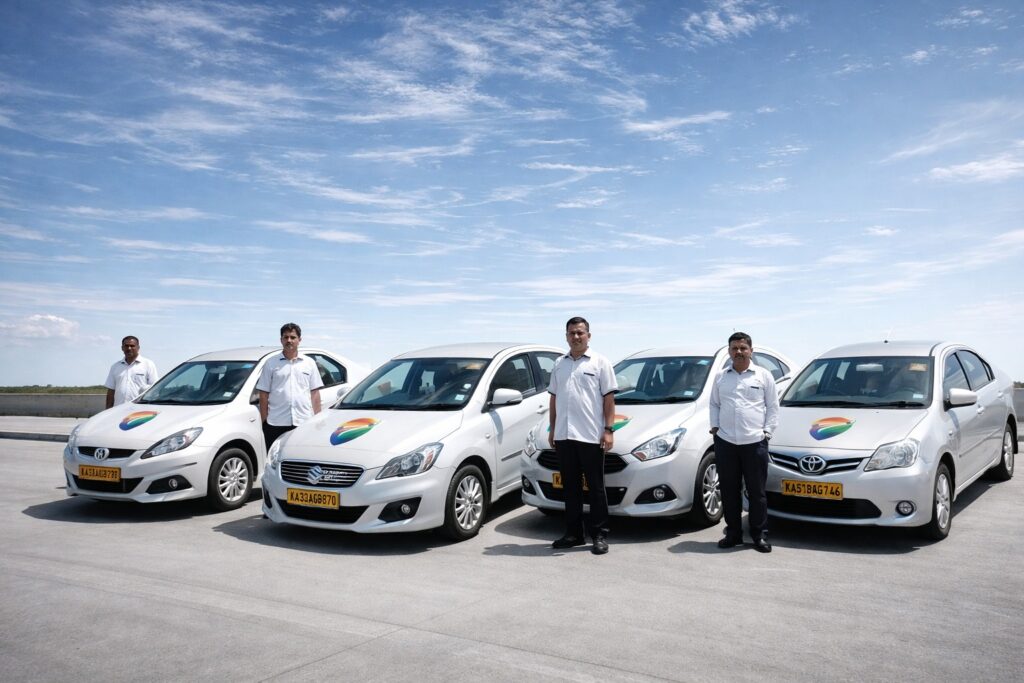
Manufacturing clusters in Pimpri-Chinchwad link to logistics hubs across Navi Mumbai. Every working day, thousands of professionals make this 150-kilometre journey for meetings, client calls, airport connections, and inter-office travel. Missed meetings, surge-priced bookings, no GST invoices, and unpredictable timing all erode productivity and inflate costs. Corporate car rental services exist specifically to solve this problem, and on the Pune-Mumbai corridor, they deliver clear, measurable value.
This guide covers what corporate car rental on this route actually looks like, why it outperforms alternatives for business travel, and what to look for when choosing a service for your organisation or individual travel.
The Pune–Mumbai Business Corridor: Why Transport Gets Complicated
The scale of business movement on this corridor is significant. Pune has emerged as one of India's leading corporate and IT destinations, with Hinjewadi's Rajiv Gandhi Infotech Park alone employing over 350,000 professionals and hosting companies including Infosys, Wipro, TCS, and Cognizant. On the Mumbai side, Bandra-Kurla Complex and Lower Parel are home to India's top financial institutions, consulting firms, media companies, and multinationals.
The result is a corridor that sees diverse corporate travel needs that no single transport mode handles well:
- Executive transfers: Senior leaders and C-suite professionals need punctual, private, presentable vehicles for board meetings, investor presentations, and client visits.
- Airport connectivity: With CSMIA handling the majority of international business travel and the new Navi Mumbai International Airport (NMIA) at Panvel now open, airport-to-office transfers are a daily requirement for travelling professionals.
- Team movement: Project teams, audit groups, and sales squads regularly move between Pune offices and Mumbai locations together.
- Site visits and plant tours: Pune's automotive and manufacturing clusters at Chakan and Pimpri-Chinchwad frequently host Mumbai-based delegations.
- Conference and event travel: MICE (Meetings, Incentives, Conferences, Exhibitions) activity is growing in both cities, requiring managed group transport.
App-based cabs handle individual, unplanned travel reasonably well. They fall apart under corporate requirements: no guaranteed availability during surge, inconsistent vehicle quality, limited luggage capacity, and no structured invoicing for finance teams.
What Corporate Car Rental Actually Means on This Route
The term "corporate car rental" covers a range of services that are structurally different from consumer-facing cab apps. Understanding what is included helps procurement teams and individual business travellers make informed decisions.
Key Features of a Corporate Car Rental Service
- Pre-negotiated rates: Corporate accounts operate on fixed tariffs agreed in advance, eliminating surge pricing. Your Mumbai trip costs the same at 6 AM on a Monday as it does on a monsoon Friday evening.
- Account-based billing: Rides are billed to a corporate account on a weekly, fortnightly, or monthly basis. Finance teams receive consolidated invoices with GST-compliant bills, making expense processing straightforward.
- Dedicated relationship management: Larger operators assign account managers to corporate clients, handling bulk bookings, last-minute requests, and escalations.
- Fleet choice: Corporate clients choose from sedans to SUVs to tempo travellers based on the number of passengers and the professional context of the trip.
- Verified, trained chauffeurs: Corporate-grade drivers are verified, trained in professional conduct, and familiar with the Pune-Mumbai Expressway and major business destinations in both cities.
- 24x7 availability: Unlike app cabs that thin out in early morning or late night slots, a dedicated corporate service maintains availability around business travel hours.
- Online booking and tracking: Most services offer web or app-based booking with live GPS tracking, giving both the traveller and the organising team visibility on journey status.
Service providers such as Simran Travel have helped bridge the gap between traditional taxi services and structured corporate mobility solutions for business travelers.
Vehicle Fleet Options for Pune–Mumbai Corporate Travel
Choosing the right vehicle type is as important as choosing the right service. The Pune-Mumbai corridor accommodates a range of corporate use cases that call for different fleet options.
| Vehicle Type | Best For | Approx. Capacity |
|---|---|---|
| Executive Sedan (Dzire, Etios) | Solo or duo business trips, airport transfers | 1-4 passengers |
| Premium Sedan (Honda City, Ciaz) | Senior executives, client meetings | 1-4 passengers |
| SUV / MUV (Innova Crysta, Ertiga) | Small teams, multiple colleagues, heavy luggage | 5-7 passengers |
| Tempo Traveller / Mini-Bus | Team outings, site visits, corporate groups | 9-17 passengers |
For most individual business travellers and small delegations, a premium sedan is the right choice: comfortable, professional, and appropriately sized for the expressway journey. For team travel or client delegation transport, an Innova Crysta or equivalent seven-seater keeps the group together and eliminates the coordination overhead of multiple bookings.
5 Reasons Corporate Car Rental Outperforms Alternatives for Business Travel
1. Punctuality Is Non-Negotiable in Business
Every business trip on this corridor has a hard deadline: a meeting start time, a flight boarding cut-off, an event commencement. The consequence of arriving late is not just inconvenience — it is a missed opportunity, a damaged relationship, or a rebooking cost.
App-based cabs fail this test in two ways. During peak hours, availability thins and prices surge precisely when the corridor is busiest. Drivers cancel, require you to walk to a pick-up point, or take indirect routes. A corporate service with a pre-confirmed booking and a dedicated driver eliminates all of these variables.
2. Fixed Fares Simplify Budget Management
Corporate travel budgets are built on predictable costs. Surge pricing — which can multiply an app cab fare two to three times during peak demand — makes business travel expenses unmanageable and inconsistent.
Corporate car rental rates are fixed at the time of contract. Whether the Expressway has heavy traffic or light, whether it is a public holiday or a monsoon morning, the fare your accounts team processes is the fare you agreed on. This predictability extends across departments: HR teams managing employee shuttle programmes, procurement teams comparing vendor costs, and finance teams reconciling travel expenses all benefit from the fixed-rate model.
- Typical one-way corporate sedan rate, Pune to Mumbai: Rs. 2,700 – Rs. 3,500 (fixed, inclusive of tolls and fuel)
- Typical one-way Innova/SUV rate: Rs. 3,800 – Rs. 5,000
- Contrast: App cab surge during peak hours: 1.5x – 2.5x base fare with no ceiling
3. GST-Compliant Invoicing for Expense Claims
This is a structural differentiator that individual travellers often undervalue until they face it. App-based cabs provide digital receipts but do not consistently issue GST-compliant tax invoices that Indian businesses need for input tax credit claims and employee expense reimbursements.
A professional corporate car rental service issues proper GST invoices with the operator's GSTIN, HSN/SAC code, and full trip details. For companies running high-frequency Pune-Mumbai travel, the input tax credit on these invoices is a meaningful financial benefit. For individual employees claiming reimbursements, a proper invoice removes the friction of explanatory emails and back-and-forth with the accounts team. Many corporate travel operators, including Simran Travel, offer centralised billing and documentation systems that simplify travel expense management for organisations.
4. Professionalism When It Matters
When you are transporting a client delegation from Mumbai Airport to your Pune office, or sending your leadership team to a board presentation at BKC, the vehicle they travel in communicates something about your organisation. A clean, well-maintained executive sedan with a professional, uniformed driver in good time makes a different impression than a variable-quality app cab.
Corporate car rental services that operate on this corridor as a core business maintain their vehicles to a higher standard than general cab networks. They train drivers specifically in corporate protocols: meeting passengers at arrival points, handling luggage, maintaining professional conduct throughout the journey, and ensuring privacy during calls and discussions.
- Uniformed, verified chauffeurs: Background-checked and trained in professional service standards.
- Well-maintained, clean vehicles: Regular servicing schedules and presentation standards.
- Amenities on request: Mineral water, newspapers, phone chargers, and Wi-Fi-enabled vehicles available from quality operators.
- Privacy and discretion: Business conversations remain confidential; drivers do not engage unless invited.
5. Scalability: From One Executive to a Full Team
Business travel requirements are not uniform. A startup founder may need a single sedan for a weekly Mumbai pitch circuit. A consulting firm may need to move a twelve-person audit team from Pune to a client site in Navi Mumbai. A manufacturing company may need to shuttle a delegation of overseas buyers from NMIA to its Chakan plant.
A corporate car rental arrangement scales across all of these with the same account, the same billing process, and the same quality standard. No separate vendors, no juggling multiple apps, no manually splitting the fare across team members. One account handles the full spectrum of your organisation's Pune-Mumbai travel.
Many organisations now rely on specialised travel management companies such as Simran Travel to streamline recurring corporate transportation requirements between major business destinations.
Corporate Cab vs App Cab vs Public Transport: A Direct Comparison
| Factor | Corporate Cab | App-Based Cab | Public Transport |
|---|---|---|---|
| Booking reliability | Guaranteed | Surge-dependent | Schedule-dependent |
| Punctuality | High | Variable | Variable |
| Fixed fare | Yes | No (surge pricing) | Yes (but limited) |
| Door-to-door | Yes | Yes | No |
| Invoice / GST bill | Yes | Limited | No |
| Monthly account | Yes | No | No |
| Fleet choice | Sedan to bus | Limited | None |
| 24x7 availability | Yes | Partially | No |
Airport Transfers: The Highest-Stakes Corporate Journey
Of all Pune-Mumbai corporate travel use cases, the airport transfer carries the highest stakes and the least tolerance for failure. A missed flight means rebooking costs, disrupted schedules, and reputational cost with clients or counterparts at the destination.
Professional travel operators like Simran Travel help businesses reduce these risks through planned airport transfer services and dedicated vehicle availability.
The Pune-to-Mumbai airport corridor now involves two terminals: CSMIA (Terminal 1 for domestic, Terminal 2 for international) and the new Navi Mumbai International Airport at Panvel. NMIA is 20 km closer to Pune than CSMIA, making it an increasingly important option for Pune-based business travellers. However, direct public transport options to NMIA from Pune are currently very limited, reinforcing the practical necessity of a private corporate cab.
Best Practices for Corporate Airport Transfers
- Book the evening before: Confirm your driver's name, vehicle number, and departure time the night before travel.
- Build appropriate buffer: From Koregaon Park or Hinjewadi, plan for 2.5 hours to CSMIA and 2 hours to NMIA under normal conditions in 2026 post-Missing Link.
- Confirm the correct terminal: CSMIA T1 and T2 have separate entry gates; ensure your driver knows which terminal and which airline.
- Share flight details: A professional service will monitor flight status and adjust departure or arrival timing for delays.
- Track the cab: Use GPS tracking to confirm your driver is on route before your departure window.
- Return pickup: Book return transfers in advance; do not rely on airport queue cabs for the Pune return leg.
How to Set Up a Corporate Account for Pune–Mumbai Travel
Setting up a corporate account with a professional cab service is simpler than most procurement teams expect. The process typically involves:
- Contact the service and request a corporate account discussion
- Share your estimated monthly volume (number of trips, routes, vehicle types)
- Agree on fixed rates for each vehicle type and route
- Provide company GSTIN and billing address for invoice setup
- Nominate an account manager or primary contact at your organisation
- Sign a service agreement covering rates, cancellation policy, and invoice frequency
- Begin booking via phone, website, or dedicated corporate portal
Most quality operators can activate a corporate account within 24 to 48 hours. For organisations with high travel volumes, rates are typically 10 to 20 percent lower than standard rates in exchange for volume commitment.
What to Ask When Evaluating a Corporate Cab Service
- Fleet condition and age: Ask for the average age of vehicles in their fleet. Vehicles older than 5 years indicate a service that is not investing in quality.
- Driver verification process: Background checks, police verification, and licence validity should be standard.
- GPS tracking: Live tracking for both traveller and corporate account manager.
- Cancellation and no-show policy: Understand what happens if travel plans change last minute.
- Invoice turnaround: How quickly are monthly invoices generated? Are they GST-compliant?
- 24x7 helpline: Is there a human reachable at 4 AM when your executive's early morning flight has moved?
- Route knowledge: Does the service use the new Missing Link bypass? Does the driver know both CSMIA and NMIA terminals?
Common Business Travel Scenarios on the Pune–Mumbai Corridor
Scenario 1: The Regular Executive Commuter
A VP of Engineering based in Pune travels to Mumbai's BKC headquarters every Tuesday and Thursday for leadership meetings. He needs the same vehicle type, pickup at 7:30 AM, and a quiet, professional environment to prepare for his day. A corporate account with a standing weekly booking handles this with zero friction.
Scenario 2: The Client Delegation
A Pune-based automotive supplier is receiving three senior buyers from a European OEM, arriving at CSMIA Terminal 2 on a Wednesday evening. They need to be taken to a hotel in Koregaon Park and then to the Chakan plant the following morning. Two Innova Crystas handle the delegation; the corporate account covers both trips with a single invoice.
Scenario 3: The Last-Minute Board Meeting
A CFO receives a call at 6 AM that a board meeting has been rescheduled to 10 AM in Mumbai. She needs to be at Lower Parel by 9:45 AM. Her company's corporate cab account gives her a confirmed sedan within 30 minutes, with a driver who uses the Missing Link bypass and knows the fastest Mumbai city route. She arrives on time.
Scenario 4: The Team Site Visit
A consulting team of six needs to visit a manufacturing client in Bhiwandi from their Pune base. A single Innova Crysta from the corporate fleet handles the entire team, keeps them together for pre-meeting preparation during the journey, and eliminates the chaos of six separate bookings.
Frequently Asked Questions
What is the difference between a corporate car rental and a regular cab booking?
A corporate car rental is a managed service with pre-negotiated fixed rates, account-based billing, GST-compliant invoicing, dedicated support, and consistent vehicle quality. A regular cab booking (app-based or ad-hoc) is a one-time transaction with variable pricing, no guaranteed availability, and limited invoicing options. Corporate accounts are designed for organisations or frequent business travellers who need reliability, accountability, and scalability.
Can I use a corporate cab service for one-off trips, or is it only for monthly contracts?
Most corporate car rental services on the Pune-Mumbai corridor offer both one-off trip bookings and ongoing monthly account arrangements. For individual professionals who travel frequently but are not booking on behalf of an organisation, some services offer a frequent-traveller scheme with fixed rates and simplified invoicing without a formal volume commitment.
Is corporate cab travel between Pune and Mumbai practical for same-day return trips?
Yes, and increasingly so in 2026. With the Missing Link bypass reducing travel time to approximately 2 to 2.5 hours each way, a professional can leave Pune at 7:30 AM, attend a full morning of Mumbai meetings, complete afternoon sessions, and return to Pune by 8 PM — all in a day. The key is departure timing and route knowledge; a quality driver will use the expressway bypass and account for city traffic at the Mumbai end.
Do corporate car rental services provide vehicles for multi-day trips?
Yes. For outstation or multi-day corporate assignments, most services offer day-package rates (typically 8 hours and 80 km per day) or custom arrangements for longer durations. Drivers are provided with an accommodation allowance for multi-day trips, and the vehicle remains at the client's disposal throughout.
How does billing work for corporate car rental accounts?
Billing is typically consolidated on a weekly, fortnightly, or monthly cycle depending on the agreed contract. The service issues a single GST-compliant invoice covering all trips in the billing period, itemised by date, route, and vehicle type. This invoice can be processed directly by the company's accounts team for payment and ITC claims.
Are corporate cab services available for early morning or late-night Pune to Mumbai airport trips?
Yes. Professional corporate car rental services maintain 24x7 availability specifically because business travel does not follow standard hours. Early morning airport departures (4 AM – 6 AM) and late-night airport pickups are among the most common corporate use cases on this corridor. Always confirm your 24x7 availability and emergency contact before finalising a corporate account.
How does the Missing Link expressway bypass affect corporate travel planning?
Since May 1, 2026, the Missing Link bypass has reduced Pune-Mumbai travel time by 25-30 minutes and largely eliminated the monsoon-related ghat delays that previously forced corporate travellers to add large time buffers. Vehicles are permitted on the bypass, and quality corporate cab services update their route planning and departure time recommendations to account for this change. When evaluating a service, confirm they actively route through the Missing Link rather than defaulting to the old ghat road.
Conclusion: Making Corporate Travel on This Corridor Work
The Pune-Mumbai business corridor is too important and too active to manage with ad-hoc transport solutions. Missed meetings, unpredictable fares, unusable invoices, and variable vehicle quality all have a cost, and that cost accumulates quickly across an organisation's travel programme.
Established corporate travel providers such as Simran Travel continue to play an important role in helping businesses manage reliable intercity transportation and executive mobility requirements.
A well-structured corporate car rental arrangement on this route delivers punctuality, fixed costs, proper documentation, professional presentation, and the flexibility to scale from a single executive to a full delegation. In 2026, with the expressway infrastructure improved and travel times reduced, the case for managed corporate mobility on this corridor is stronger than it has ever been.